You can install Redshift in Houdini if you have bought Maxon One subscription. First find your Redshift folder. It should be in:
C:\ProgramData\redshift\
Then open houdini.env, in Windows you will find it your documents folder
C:\Users\Your_name\Documents\houdini19.5.
I use Sublime Text Editor. Add these lines to your houdini.env file, at the end of it. Change (YOUR_HOUDINI_VERSION) with the latest version of redshift you find in C:\ProgramData\redshift\Plugins\Houdini\19.5.435.
HOUDINI_DSO_ERROR = 2
PATH = "C:\ProgramData\redshift\bin;$PATH"
HOUDINI_PATH = "C:\ProgramData\redshift\Plugins\Houdini\(YOUR_HOUDINI_VERSION);&"
If it doesn’t work and if you can’t see Redshift on the shelf when you launch Houdini, try to retype all the paths and not copy and paste them. It happened to me and this fixed the problem.
If you need your particles or points to be rendered with constant size according to your camera, in Houdini, this is what you could do.
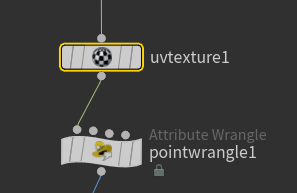
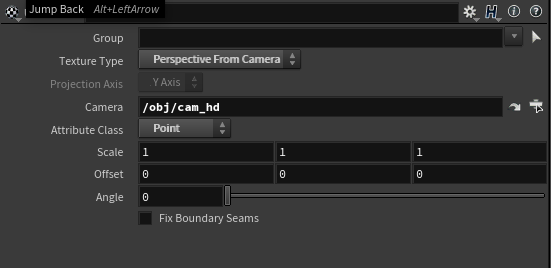
- Add a UV Texture SOP.
- Change texture type to Perspective from Camera.
- Insert your Camera path.
- Change attribute class to Point.
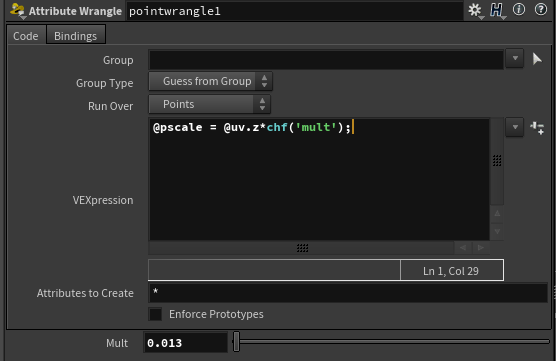
- Add a Point Wrangle SOP.
- We want the scale of the particles to be connected to the distance of the camera. This is the @uv.z. We want also to control the overall size of the particles, so we add a control multiplier.
@pscale = @uv.z*chf('mult');
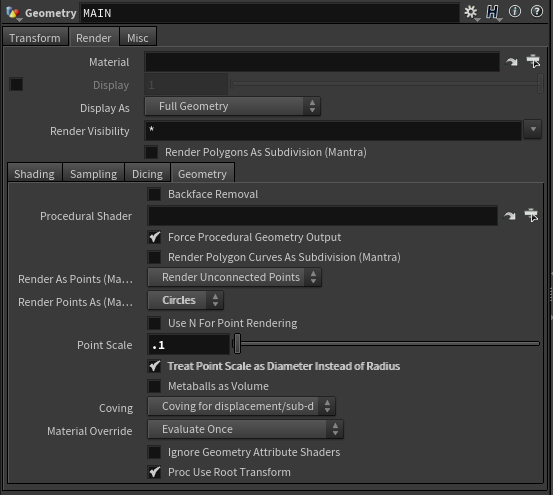
- In the /obj, be sure to check that Render Unconnected Points or Render Only Points are active. Here you can also control the size of the particles again. If you don’t want the particles to be rendered as Spheres, select Circles.
- Starting from the basics:
- SOP: surface operator, geometry network
- DOP: dynamic operator, dynamic network
- VOP: vex operator, vex builder network
- SHOP: shader operator, shader network
- CHOP: channel operator, motion/audio network
- COP: compositing operator, img network
- ROP: render operator, out network
- POP: particle operator, particle network
- Points, vertexex, primitives. Vertexes are part of a primitive. Points are the lowest level attribute of any data type you can have. Like weight, null, nurbs. You can have a primitive in one point, for example. A point is where Houdini stores all the informations about something. Makes sense. You move your camera in your viewport with your spacebar pressed.
- Set Driver / Set Driven in Houdini: to parent the position or whatever of one object to another, highlight the attribute, right click Copy parameter. On the second object Paste Copied Relative References. To see the expression, click on the attribute name. It will cycle between the value and the expression. Dark green on the values means that there’s an expression beneath.
- The simple expression created to parent the position of one object to another is going to be
ch("../circle1/tx")
ch means channel.tx means translate x.. means going back one level, inside the same network, to the circle1, to the position x.- you can see that tx means translate hovering the mouse on position. You can get all the parameters names just hovering the mouse with ctrl pressed.
- The expression is saying: I need to pull a channel from a node that it’s not myself, that is called circle1 and the value is tx.
- We can change the values of our expressions as well.
ch("../circle1/tx") + .05
- If we hover the mouse on the value we added, we can use the value ladder clicking the MMB.
- Access variables in SOP: you have to use a grave accent `. So, for example, to use a @path variable in the material, you can use this snippet
$HIP/tex/`@path`
- Write code in SOP, for example in group: don’t use spaces! For example, if you want to create a group with the type
@type == 1, instead you have to write @type==1
- World coordinates: M
- Variables on parameters:
Going back doing another tutorial to better understand how Houdini works.
This series is specifically for who is coming from C4D.
recreating mograph in houdini -1 cloner object
in attribcreate you can add
pscale
scale
orient
$PT point
$NPT total number of points
with Attribute Wrangle you can easily create attributes.
f@fall = 0;
SOPs
- Resample: use it to generate tangent, curve, ptdist, curvenum.
- CurveU goes from 0 to 1, from the beginning of the curve, to its end.
- Generate points from volume:
- VDB from Polygon + Scatter
- IsoOffset + Scatter
- Points from Volume
FLIP
- Flip Object
- Input Type: it could be Surface SOP if you have a polygon or Particle Field if you have already points
VEX
- VEX documentation
- to declare a variable:
int nameofthevariable; // create a integer variable
vector nameofthevariable; // create a vector variableFetching vector P
‣ @P // fetch first input P
‣ @opinput1_P // fetch second input
‣ @opinput?_P // fetch ?th input
Fetching float foo
‣ f@foo // fetch first input foo
‣ f@opinput1_foo // fetch second input
‣ f@opinput?_foo // fetch ?nt input
/*

my comment block

*/
f@myattrib = 1.0; // f means floating point. This line means that I’m creating a new variable, called myattrib, it’s a floating number and it’s 1.
@N = @N; // initialise the normals
@UP = {0,1,0}; // this is the way we initialise the vectors, with the up on Y
@Cd = @Cd; // initialise the colors
- Common functions
-
fit() take a number between 2 values, fit it between 2 other values, usually 0-1.
- Eg, remap @u from range -5,20 to 0-1: foo = fit(@u, -5, 20, 0, 1);
rand() generate a random number between 0 and 1.
- Usually feed it the point id, so each point gets a random number: foo = rand(@ptnum);
sin(), cos() as you’d expect, but in radians.radians() convert a number from degrees to radians: foo = radians(90);length() measure the length of a vector. Eg, measure the distance of a point from the origin: dist = length(@P);distance() measure the distance between two points: dist = distance(@P, v@mypoint);abs()Returns the absolute (positive) equivalent of the number. For vectors, this is done per-component
- Built-in attributes
- @ptnum – the point id
- @numpt – total number of points
- @Time – current time, in seconds
- @Frame – current frame
- @primnum – the primitive id
- @numprim – the total number of primitives
- Create Floating Slider:
@foo *= chf('name');
Expression functions
Reminder, check this link!
Expression functions are different from VEX expressions.
Expression functions are for Hscript, the expressions in network parameters.
npoints returns the number of points in a geometry. npoints(surface_node).
opinputpath returns the full path of the node connected to a given input. opinputhpath(“.”,0) it returns the input connected to the sop.
for example: npoints(opinputhpath(“.”,0)) it will return the number of the points of the curve connected to the attribute create sop.
$PT point number

$NPT Total number of point

$CR Diffuse point color red

$CG Diffuse point color green

$CB Diffuse point color blue

$PR Primitive or profile number

$NPR Total number of primitives or profile number

$F Frame number
The Copy sop has a great feature that is the stamp, where you can control the individual copies.
Check stamp inputs, write the variable.
You can then add $CY, number of copies.
With op:`opinputpath(".",1)` you connect through expression the sop to its second input.
Attrib Delete:
* to delete everything
^nameoftheattrib to save that attribute
Tutorial and classes
Video tutorial
E-Books
Some free ebooks and pdfs I’ve found online about Houdini
You can download the Houdini project here. I had a bit of fun with Point VOPs, nothing crazy.
GastaLoop 103
Following this tutorial that creates trails from volumes.
Playing with some splines. In Houdini you create them with the Curves sop.
Resample to subdivide splines.
Polyframe to generate tangents from points.
Press X to create a Visualize node.
A nice way to invert tangents from points is with an Attribute Wrangle and this code
v@tangent = @tangent * -1;
Just be careful when declaring the type of variable. A tangent is a vector, not a float.
The Volume sop has some interesting parameters:
- Rank
- Scalar
, each voxel holds just one value.
- Vector
, each voxel holds three values.
- Matrix
, each voxel holds nine values.
If you want to use the tangents in your Volume, you have to use a Vector rank.
Careful about Name parameter of Volume sop. It’s not “just a name”. It’s absolutely important.
Naming volumes allows mantra and the Volume VOP to override the correct parameters with the values of the volume.
The input of the Volume sop is Bounding Source. It’s the Bounding Source of the geometry! When you create a Volume it will look at the boundary box of your object. If you want to increase the Volume boundary box, use a Bound sop, not a Volume Bound!
Volume Vop allows us to write vex for volumes.
When you’re working with vector, remember to change Bind export to vector!
These are Vops that I used in the Volume Vop.
Point Cloud Open: this node opens a point cloud file and searches for points around a source position.
Pount Cloud Filter: allows us to choose an attribute (channel) from the point cloud.
Length: it calculates the lenght of a vector.
Volume Trail sop: computes a trail of points through a velocity volume (from the help!).
Remember: VDB from Polygon to create a volume from polygons.
Some VEX here.
VEX stands for Vector Expressions.
SHIFT + R to reverse the node inputs.
The full list of VEX functions is here.
to declare a variable:
int nameofthevariable; // create a integer variable
vector nameofthevariable; // create a vector variable
Fetching vector P
‣ @P // fetch first input P
‣ @opinput1_P // fetch second input
‣ @opinput?_P // fetch ?th input
Fetching float foo
‣ f@foo // fetch first input foo
‣ f@opinput1_foo // fetch second input
‣ f@opinput?_foo // fetch ?nt input
/*

my comment block

*/
f@myattrib = 1.0; // f means floating point. This line means that I'm creating a new variable, called myattrib, it's a floating number and it's 1.
@N = @N; // initialise the normals
@UP = {0,1,0}; // this is the way we initialise the vectors, with the up on Y
@Cd = @Cd; // initialise the colors
In the past few days I’ve jumped between tutorials and, to be honest, the more I watch them, the more I understand.
The last one I’ve done is just brilliant, about reaction diffusion, by Entagma.
And, finally, I’ve been able to render an animation!
So, I’ve just finished the first big tutorial on Digital Tutors.
More free Houdini tutorials here:
http://www.gridmarkets.com/johnny-farmfield.html
https://vimeo.com/user2030228/videos
But before I start on those, I’ll dive into Dynamics a bit more with another Digital Tutors tutorial.
Cloth object
If some penetrations happen, check the cloth thickness in collisions.
The main controls for the Cloth are in Model, like C4D: stiffness, damping, density.
Stiffness: how much cloth is resisting deformations.
Density: how heavy is the cloth?
Damping: how quickly the cloth will settle down, it’s how much it’s springy
Houdini